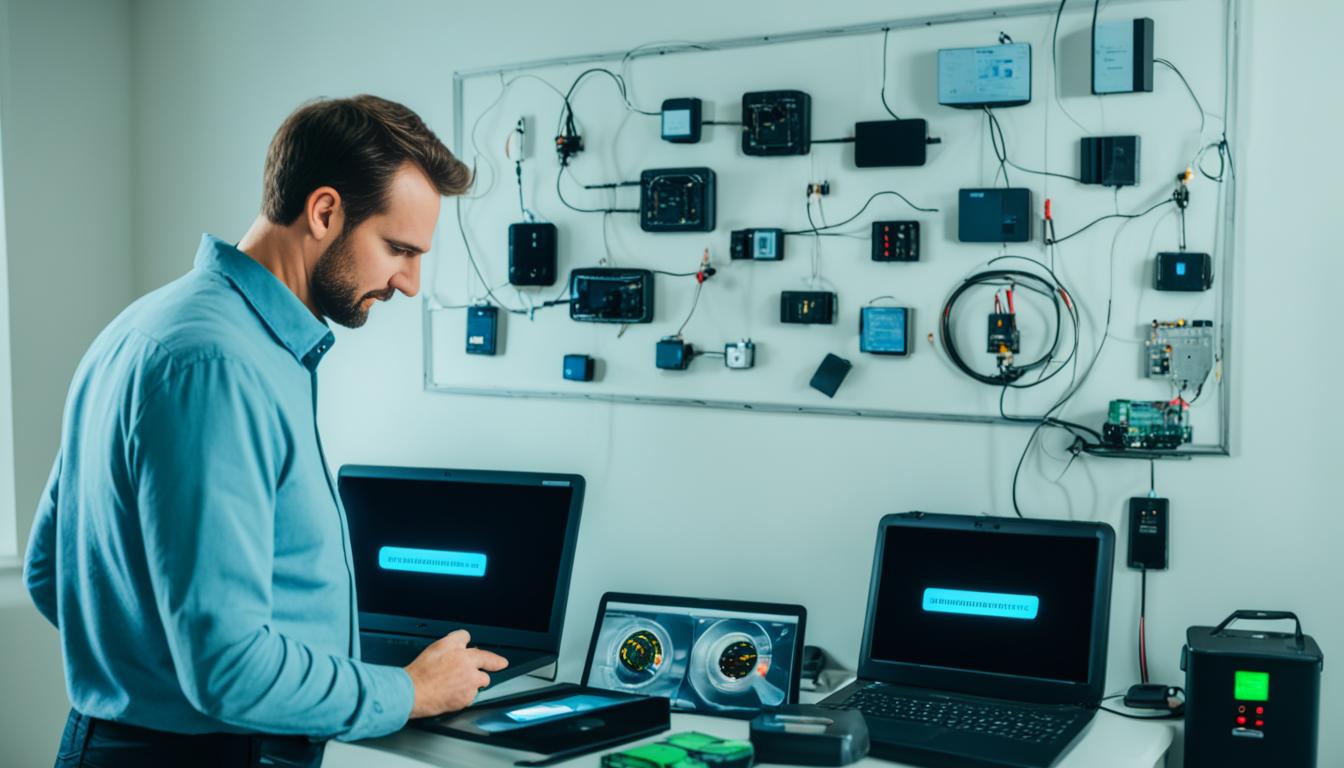
Everyday Sources of EMFs are all around us, from the microwave heating your morning coffee to the power lines running along neighborhood streets. These electromagnetic fields come from both natural sources like the earth’s magnetic field and artificial sources created by modern technology.
Understanding where these fields originate helps you make informed decisions about your daily exposure. Most people encounter dozens of EMF sources throughout a typical day without realizing their presence or potential impact.
TL;DR
- Microwaves emit EMFs at 2.45 GHz frequency and can leak small amounts even when the door is properly sealed.
- Power lines create 60 Hz extremely low frequency fields that extend 100-200 feet from high voltage transmission lines.
- Cell phones produce radiofrequency EMFs between 800-2100 MHz during calls and data transmission.
- Household appliances like hair dryers and electric razors generate some of the highest EMF readings at close range – often 100-500 milligauss.
Everyday Sources of EMFs in Your Home
Your home contains numerous EMF-generating devices that operate throughout the day. Kitchen appliances represent some of the strongest sources, with microwaves producing intense radiofrequency fields during operation.
The refrigerator motor creates magnetic fields when the compressor cycles on and off. Hair dryers, electric shavers, and vacuum cleaners generate particularly high EMF levels due to their powerful motors, though exposure time is typically brief.
Kitchen and Bathroom EMF Sources
- Microwave ovens – operate at 2.45 GHz and can leak small amounts of radiation through door seals.
- Induction cooktops – create strong magnetic fields directly above the cooking surface.
- Electric can openers – produce high EMF spikes during operation due to powerful motors.
- Hair dryers – generate 60 Hz magnetic fields of 100-500 milligauss at typical use distance.
- Electric toothbrushes – create localized fields during charging and use.
Wireless Technology EMF Emissions
Wireless devices have become central to daily life, each contributing to your overall EMF exposure. Wi-Fi routers broadcast continuously at 2.4 GHz and 5 GHz frequencies to maintain network connectivity.
Cell phones adjust their power output based on signal strength, transmitting more intensely when reception is poor. Bluetooth devices operate at lower power levels but maintain constant communication with paired devices.
Common Wireless EMF Sources
- Wi-Fi routers – broadcast 24/7 at radiofrequencies to maintain internet connectivity.
- Cell phones – emit varying power levels depending on distance to cell towers.
- Bluetooth devices – use frequency hopping spread spectrum technology for short-range communication.
- Wireless security systems – transmit periodic signals to central monitoring stations.
- Baby monitors – operate continuously on dedicated frequencies for audio/video transmission.
Quick EMF Reduction Tip
Keep wireless devices at least 3 feet away from your body when possible. This simple distance dramatically reduces exposure intensity since EMF strength decreases rapidly with distance.
Power Infrastructure and Electrical Systems
The electrical infrastructure powering your neighborhood creates substantial EMF fields. Power lines carry high voltage electricity that generates both electric and magnetic fields extending hundreds of feet from transmission lines.
Your home’s electrical wiring creates smaller but more consistent fields throughout living spaces. Ground current from utility systems can flow through plumbing and create unexpected EMF sources in kitchens and bathrooms.
Electrical Infrastructure Sources
- High voltage transmission lines. Create the strongest power frequency fields in residential areas.
- Neighborhood distribution lines. Carry electricity from substations to individual homes at lower voltages.
- Home electrical panels. Concentrate multiple circuits in one location, creating localized field concentrations.
- Electrical wiring. Every energized wire in your home contributes to ambient EMF levels.
- Ground current. Flows through metal pipes and creates unexpected EMF sources.
Transportation EMF Sources
Modern vehicles contain numerous electronic systems that generate EMF fields during operation. Electric and hybrid cars use high voltage battery systems and powerful electric motors that create unique exposure patterns.
Public transportation exposes passengers to EMFs from propulsion systems, Wi-Fi networks, and cell phone boosters installed in buses and trains. Air travel involves exposure to cosmic radiation at high altitudes plus onboard electronic systems.
Vehicle-Related EMF Exposure
- Electric vehicle motors – generate magnetic fields from high current battery systems.
- Car electronics – include GPS, Bluetooth, and cellular connectivity features.
- Public transit systems – use electric propulsion and passenger Wi-Fi networks.
- Aircraft systems – combine navigation electronics with altitude-related cosmic radiation exposure.
Office and Workplace EMF Sources
Modern workplaces concentrate multiple EMF sources in shared spaces. Office Wi-Fi networks operate at higher power levels to serve many simultaneous users across larger areas.
Fluorescent lighting creates both magnetic fields from ballasts and electrical noise that can interfere with sensitive equipment. Copy machines, printers, and computer monitors all contribute to cumulative workplace exposure.
Common Office EMF Sources
- Fluorescent lighting – ballasts create magnetic fields and electrical noise throughout office spaces.
- Computer equipment – monitors, CPUs, and peripherals generate various EMF frequencies.
- Copy machines – use high voltage for printing processes and create substantial localized fields.
- Industrial Wi-Fi – operates at higher power than residential systems to cover large areas.
- Security systems – include motion sensors, cameras, and communication equipment.
Natural vs Artificial EMF Sources
Natural EMF sources provide important context for understanding artificial exposure levels. The earth’s magnetic field measures about 0.5 Gauss and has remained relatively constant throughout human evolution.
Atmospheric electricity from thunderstorms creates temporary spikes in natural EMF levels. The EMF spectrum includes both ionizing and non-ionizing radiation, with most everyday sources falling in the non-ionizing category.
Frequently Asked Questions
Which household appliances produce the strongest EMF fields?
Hair dryers, electric shavers, and vacuum cleaners typically produce the highest EMF readings due to their powerful motors, often measuring 100-500 milligauss at normal use distances.
How far do power line EMF fields extend?
High voltage transmission lines create detectable EMF fields extending 100-200 feet on either side, while neighborhood distribution lines affect smaller areas within 50-100 feet.
Do turned-off electronic devices still emit EMFs?
Many devices continue emitting low-level EMFs when plugged in due to standby power circuits, clocks, and remote control receivers that remain active.
Are natural EMF sources stronger than artificial ones?
Natural sources like the earth’s magnetic field are generally weaker than many artificial sources, though atmospheric events like lightning can create temporary high-intensity natural EMFs.
How can I identify EMF sources in my environment?
EMF meters can help locate and measure various field sources, allowing you to map EMF levels throughout your living and working spaces.
Final Thoughts
Everyday Sources of EMFs surround us in modern life, from essential appliances to communication technologies that have become indispensable. Understanding these sources helps you make informed choices about exposure levels and protection strategies.
Start by identifying the strongest sources in your environment and implementing simple distance and time-based reduction techniques where practical.


The information on this website is for general purposes only and is not a substitute for professional financial advice.
Always consult a financial professional before making decisions.